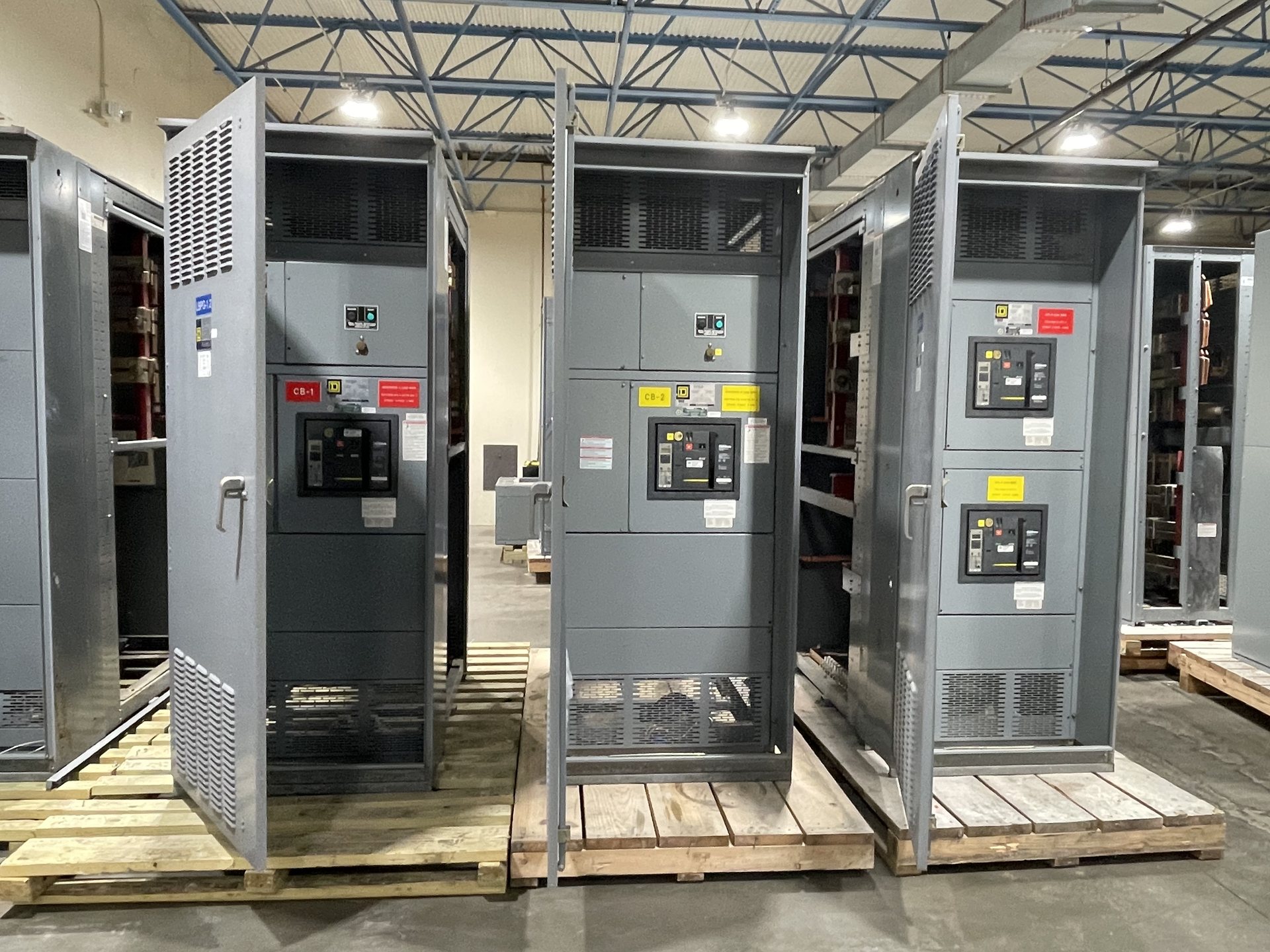
Start with the asset list, not the brand name
When an inventory identifies equipment as Square D low-voltage switchgear, treat that wording as a seller-reported marking to reconcile—not as proof of a model, configuration, age, or product history. Compare the list with existing records and safe exterior information already available. If the asset register names a lineup but no matching record can be confirmed, mark the relationship as uncertain rather than assuming every nearby section belongs to it.
A hypothetical lineup might contain a main section, several feeder sections, and an adjacent cabinet that appears to be associated with the assembly. The seller’s list may count these as one asset, while records may enumerate sections separately. Describe the apparent arrangement and the source of each identification, but do not assert that cabinets form one complete lineup unless existing documentation supports that conclusion.
Reconcile sections and visible ratings carefully
For each section that can be identified from an existing, safe exterior view or record, note its apparent role—such as main or feeder—separately from its visible marking. If a breaker rating or bus rating is readable in an existing photograph or document, transcribe it as shown and identify the source. A visible number is not, by itself, confirmation of the equipment’s full configuration or operating condition.
Keep rating fields distinct. A lineup’s bus marking, a breaker’s visible rating, and an asset-list description may refer to different components or levels of the assembly. If the documents use different descriptions, preserve both and flag the discrepancy for review rather than choosing one as correct. Do not infer missing ratings, electrical characteristics, or compatibility from the Square D name or from another section’s marking.
Use drawings without overstating what they prove
Available section drawings, schedules, or prior asset records can help reviewers understand what the seller intends to include. Share existing copies if accessible, and identify their apparent scope: a drawing might describe a lineup generally without accounting for later changes or every section now present. If a revision identifier or date is shown, report it as printed; do not assume that it matches the equipment unless that connection is documented.
When drawing coverage is unclear, say so plainly. For example, a record might show a main and feeder arrangement while the offered group includes an additional cabinet whose place in the drawing is unknown. That is a useful qualification, not a reason to reconstruct the configuration. Do not open equipment, test it, energize it, or handle electrical components to resolve a paperwork gap; seller testing is not required.
Separate included equipment from gaps and exclusions
The equipment a seller proposes for sale may include a complete documented lineup, selected sections, or equipment described as incomplete. Reconcile the proposed sale against the asset list by naming the sections believed to be included and noting any known exclusions. If a section is absent from the available list, or the records do not establish whether it is included, label that point unknown rather than silently counting it as part of the sale.
Note missing components only when the information is already known from records or safe exterior observation. A blank space, covered area, or unclear photograph does not establish that a component is missing. If a breaker, section, or other item is recorded as absent, distinguish that recorded fact from any assumption about why it is absent or what would be needed for the lineup to be complete.
Keep revisions, identity, and condition in separate fields
Different labels or drawings may reflect a revision, a documentation mismatch, or another explanation; without supporting records, the cause remains unknown. Preserve the exact wording visible in each source and indicate whether a detail came from an asset list, drawing, or existing photograph. This makes discrepancies reviewable without turning a seller-reported brand marking into a confirmed model identification or product history.
Condition should be described with the same restraint. Existing records may identify equipment as surplus or decommissioned, but that status alone does not establish completeness, operability, or value. Florida Switchgear Buyers considers used, surplus, and decommissioned switchgear and related equipment across voltage classes, including equipment from decommissioned data centers and closed power plants. Any offer and precise assets purchased depend on review; no acceptance or compatibility should be presumed.
Prepare a safe, useful purchase review
A practical submission can pair the seller’s asset list with available drawings and exterior photographs, while labeling unknown sections, ratings, revisions, or inclusion status. Use only material already accessible without electrical work. Do not ask staff to open, test, energize, isolate, disconnect, move, or otherwise handle equipment for documentation. Qualified professionals alone should handle electrical equipment, and no seller testing is necessary for a review request.
Florida Switchgear Buyers makes cash offers and pays upfront for equipment purchased. For purchased assets, it handles crane, rigging, disconnects, loading, freight, and hauling; this is equipment purchasing and removal, not a promise of facility demolition or general electrical services. To discuss the records and equipment under consideration, contact (614) 715-3047 or saleselectricalbuyers@gmail.com. The offered scope remains subject to review.