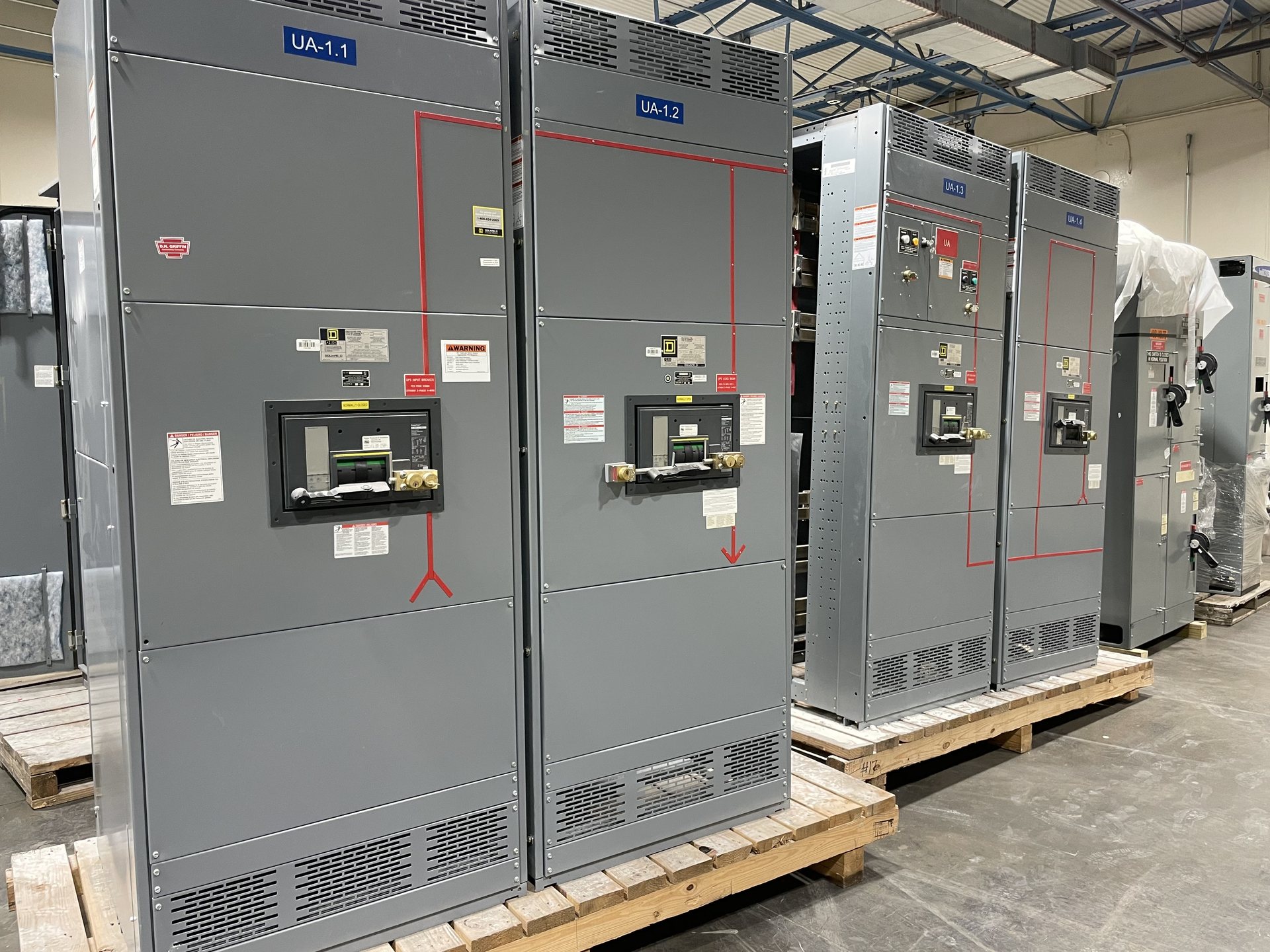
Start with the inventory, not assumptions about the installation
An authorized seller in St. Johns County may find busway represented in a surplus inventory as a mixture of straight runs, removable tap-off boxes, and accessories rather than as one complete system. Treat that description as a starting point, not proof that all listed pieces belong together. A sale review is more useful when the inventory distinguishes what is physically present from what records merely associate with the lot.
For a hypothetical lot, compare the count recorded for each type of item with the count shown in existing photographs or asset records, where available. If a list says twelve tap-off boxes but documentation depicts only some of them, report the listed quantity and identify the visible count separately. Do not resolve discrepancies by handling equipment; mark the difference for review and leave any unverified quantity unknown.
Separate tap-off boxes from busway runs
Tap-off boxes and busway runs are related inventory categories, but they should not be collapsed into a single count. A box may be listed as removable while runs are recorded by section or length; the terms in an old schedule may not match the actual lot. Preserve the seller’s recorded descriptions and indicate which entries refer to boxes, runs, or other components, rather than inferring a system configuration.
If a hypothetical record associates several boxes with a particular run, keep that association labeled as documented, reported, or unknown. A prior location or project reference does not establish that the pieces remain together or are compatible. This distinction helps a buyer evaluate the listed assets without representing uncertain relationships as fact, and it lets the seller disclose uncertainty without delaying an inventory simply because the original arrangement is unclear.
Record externally visible ratings carefully
Where existing photographs or accessible labels show ratings, transcribe the markings as they appear and connect each entry to the item identifier, if one exists. Keep voltage or other rating information tied to the marked item rather than applying a value across the entire lot. A shared inventory heading or similar appearance is not enough to establish that every box and run has the same rating.
If a label is obscured in existing material, absent from the records, or difficult to read, enter “unknown” instead of completing the field from a nearby item or memory. Sellers do not need to test equipment for an offer review. Do not open enclosures or approach equipment to obtain more information; only qualified professionals should handle electrical equipment, and any inspection or handling must remain with them.
Account for fittings without overstating completeness
Fittings can be important to describe separately from the main runs and boxes. A hypothetical inventory might list elbows, end pieces, supports, or other accessories, but those names should follow existing records or clear, accessible documentation. Record a stated quantity when one is available, and distinguish it from an uncounted grouping or a generic note such as “fittings included.” Avoid claiming that a set is complete unless the available records substantiate that description.
A sale review can account for listed accessories while leaving fit, condition, and intended use open for evaluation. If a fitting is associated with a particular run only by a handwritten note or recollection, identify that source rather than treating the match as confirmed. Missing accessories do not establish that the remaining equipment is unusable, just as a listed collection does not prove that it forms a ready-to-install system.
Make uncertainty legible in a mixed surplus lot
A concise inventory can separate confirmed entries, seller-reported information, and unknowns. For example, the seller might identify a documented count of boxes, a separately recorded quantity of runs, and an unknown relationship between them. That is more informative than forcing the lot into a single system description. Include existing accessible photos or records when available, but do not create a claim about condition, compatibility, age, or operating history that those materials cannot support.
Florida Switchgear Buyers reviews used, surplus, and decommissioned electrical switchgear and related equipment across all voltage classes, including equipment from decommissioned data centers and closed power plants. That scope does not establish that any particular busway lot will be purchased. The precise assets and any offer depend on review; an incomplete association or unknown marking should be disclosed, not silently converted into a confirmed specification.
Consider sale and removal only for assets purchased
For equipment it purchases, Florida Switchgear Buyers makes cash offers, pays upfront for purchased equipment, and handles crane, rigging, disconnects, loading, freight, and hauling for those assets. These arrangements concern purchased equipment; they are not a commitment to buy every listed run, box, or fitting. They also should not be read as a promise of wholesale facility demolition or general electrical contracting. Any removal work must be limited to the assets included in the purchase.
A seller considering a St. Johns County inventory may share existing item lists, accessible photographs, and known markings without testing or moving anything. For a review, contact Florida Switchgear Buyers at (614) 715-3047 or saleselectricalbuyers@gmail.com. Qualified professionals alone should handle electrical equipment; the seller should not open, test, energize, isolate, disconnect, or move it to support the inquiry. Unknown details can remain explicitly unknown while the proposed lot is evaluated.