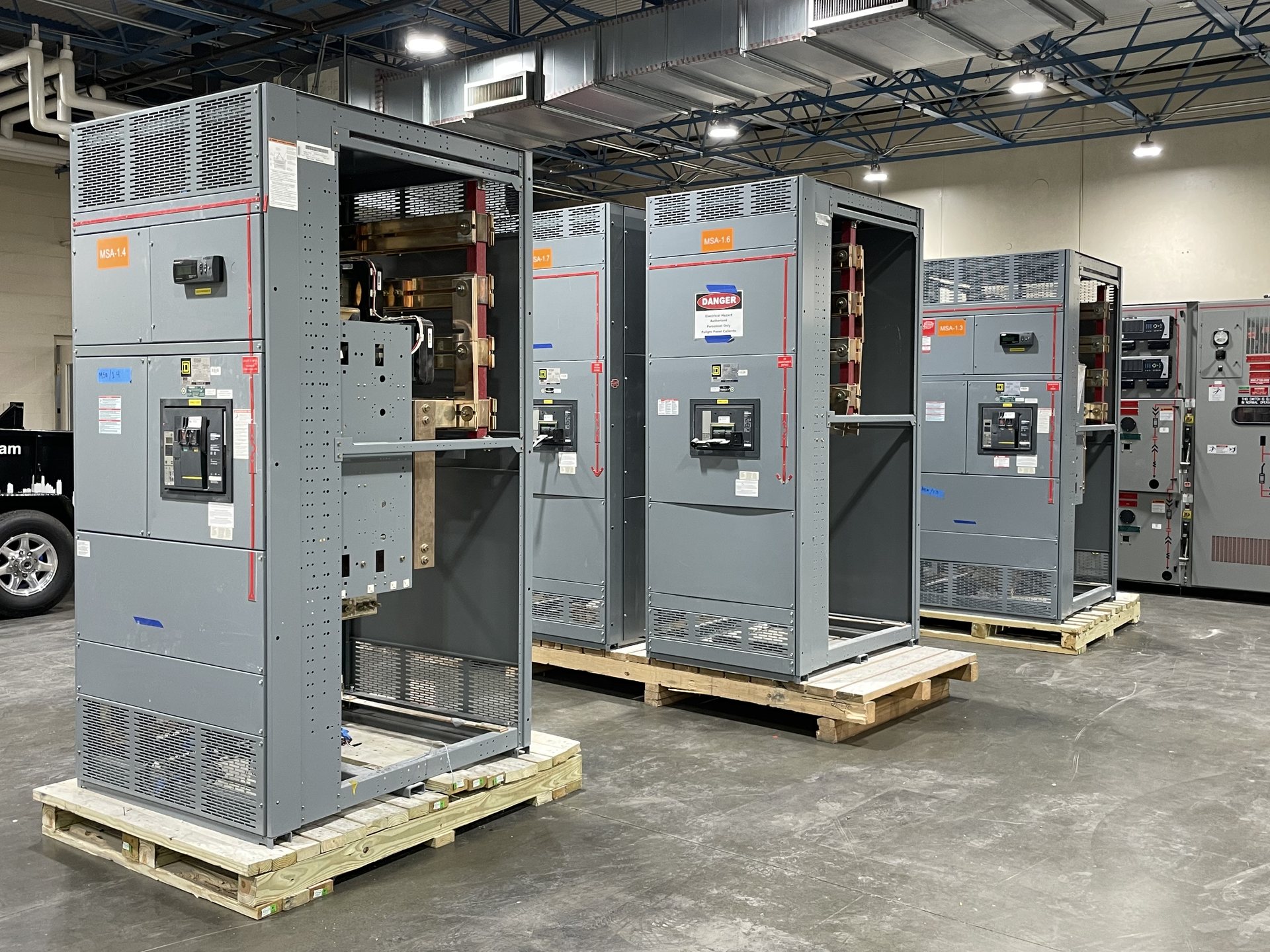
A hypothetical lot needs an inventory before a sale decision
Imagine a hypothetical Florida facility preparing to retire an industrial area. Its owner is considering whether a mixed lot of switchgear, switchboards, motor control centers (MCCs), and spare components could be sold rather than treated as one undifferentiated clearance. That decision starts with identifying what may be included, what remains in service, and what is still uncertain—not with opening cabinets or arranging removal.
The categories matter because equipment that appears together in a room is not necessarily one saleable asset group. A switchboard may be distinct from switchgear, while an MCC contains motor-control sections that should not be casually described as switchgear. The owner can prepare an initial inventory from existing labels, records, and accessible photographs; qualified professionals, not the seller, handle any equipment work.
Separate the principal equipment groups
Create separate inventory headings for switchgear, switchboards, and MCCs, then assign each visible assembly or group a neutral identifier. Record only what existing records or safely accessible exterior labels support, such as a manufacturer name or an apparent lineup designation. If the exact type, rating, or configuration is not documented, mark it unknown rather than inferring it from appearance or neighboring equipment.
A mixed lot may include different voltage classes or equipment serving different parts of a facility, but proximity does not establish common specifications or a shared operating role. Keep each known group distinct, and note when a boundary between sections is unclear. Florida Switchgear Buyers considers used, surplus, and decommissioned electrical switchgear and related equipment in all voltage classes; any offer and the precise assets purchased depend on review.
Keep documentation attached to the right group
Gather existing accessible records by equipment identifier, not merely by room or folder. Useful material may include available nameplate photographs, drawings, equipment schedules, manuals, or prior asset lists, but their presence should not be assumed. If a document cannot be matched confidently to one lineup or MCC, place it in an unmatched-record group and state what is uncertain instead of presenting the association as established.
A concise index can show which records accompany each equipment group and identify gaps without trying to resolve them through testing. For example, a drawing may appear to cover several sections while the inventory lists only one confirmed identifier; note that discrepancy for review. Sellers do not need to test equipment. Existing documentation and photographs can be shared, while missing specifications or history remain explicitly unknown.
Mark uncertain components and boundaries
Mixed lots can contain components whose purpose or ownership is not clear from an exterior view: a loose part may be a spare, an installed component may belong to an adjacent assembly, or a section may remain in service. Record these as questions tied to a location or inventory identifier. Do not remove covers, manipulate components, energize equipment, or attempt to establish condition; only qualified professionals should handle electrical equipment.
Use separate labels such as “identified,” “possible association,” and “unknown” in the inventory, and explain the evidence behind an identification when available. Avoid converting a visual resemblance into a claim of compatibility or completeness. If an item’s status cannot be confirmed from existing records or accessible photographs, leave it unresolved for review. This makes the possible purchase scope clearer without implying that every listed item will be accepted.
List spares and retained equipment separately
Available spares deserve their own inventory section rather than being silently added to a switchgear or MCC group. Describe each item only as far as existing records allow, and note whether its association with a particular assembly is documented, suspected, or unknown. A spare that looks similar to an installed component is not thereby proven interchangeable. Its inclusion in a potential sale remains subject to review along with the equipment it may relate to.
Identify equipment the facility intends to retain in a separate retained-assets schedule, using existing asset identifiers where possible. This distinction is especially important when a room contains both retired equipment and assets that still serve operations. The potential transaction concerns equipment purchased, not wholesale facility demolition or general electrical services. Do not arrange seller-led disconnection, movement, or loading; purchased-equipment work is handled by qualified personnel.
Submit a review-ready lot description
A useful submission brings together the three principal equipment groups, their identifiers, associated and unmatched records, uncertain components, available spares, and retained assets. Add photographs only when they are already safely accessible, and distinguish documented facts from estimates or unknowns. This organization helps reviewers consider a mixed lot without requiring the seller to test it or resolve technical questions through hands-on inspection.
Florida Switchgear Buyers makes cash offers and pays upfront for equipment purchased; the offer and exact purchase scope are contingent on review. For a discussion, contact (614) 715-3047 or saleselectricalbuyers@gmail.com. For purchased equipment, the company handles crane, rigging, disconnects, loading, freight, and hauling. That scope applies to equipment purchased and does not represent general facility demolition or a promise that every item in a proposed lot will be bought.