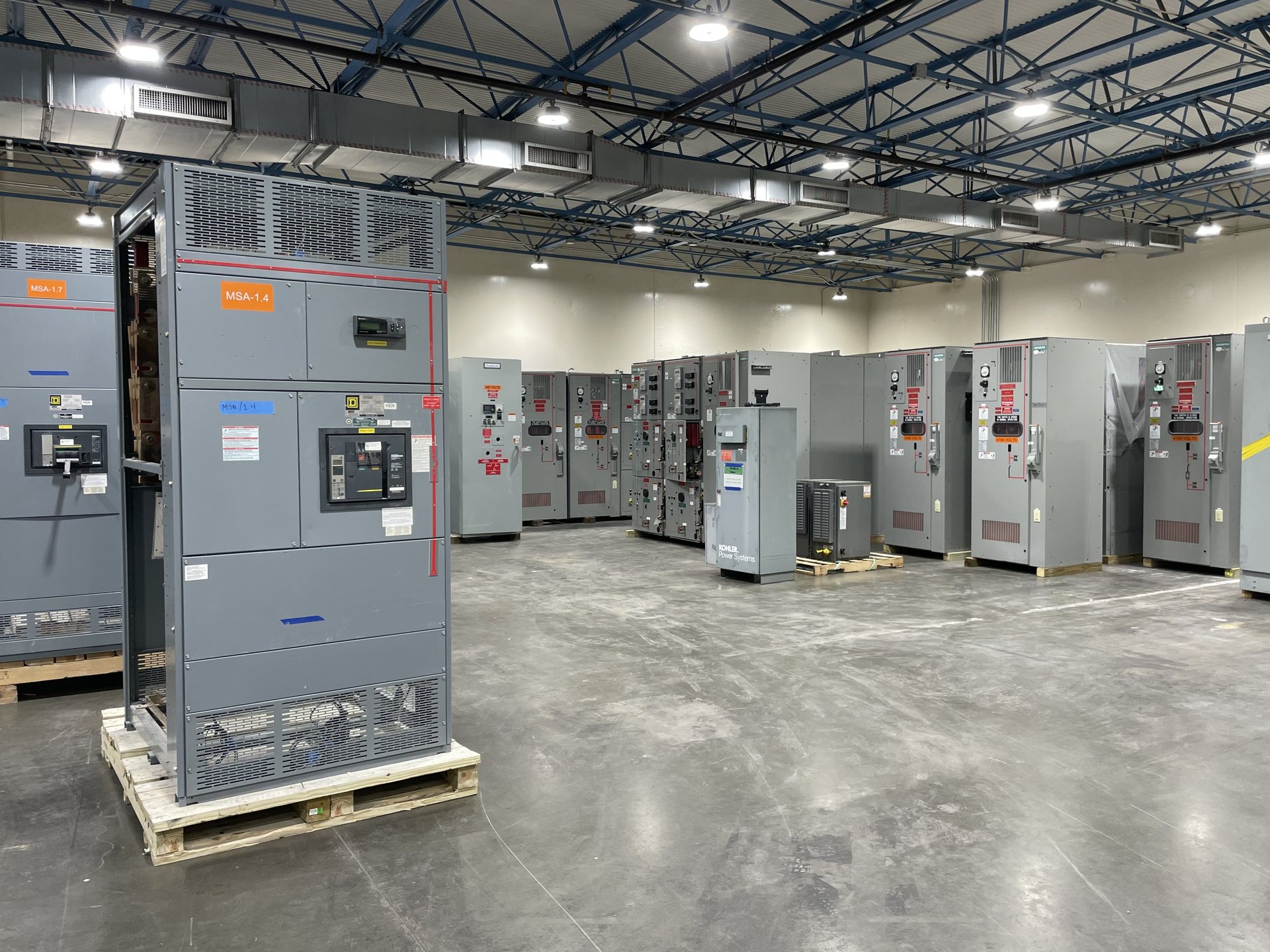
Start with the lot’s boundaries
A mixed motor control center (MCC) bucket lot can include visibly different units, repeated units, and pieces whose original lineup is unknown. Describe what is actually included rather than treating the lot as a complete MCC or a matched set. If the available records identify a defined group, note that; otherwise, call it a collection of buckets and leave its original scope unresolved.
Distinguish buckets from related equipment that may be stored nearby. A photograph or inventory can show which items are presented for consideration, but proximity alone does not establish that a loose component belongs with a particular bucket. If inclusion is uncertain, identify it separately as unassigned rather than silently adding it to the count or describing the lot as complete.
Record visible manufacturer and catalog details
For each visually distinguishable group, transcribe the manufacturer name and catalog or part number exactly as shown on accessible labels or existing records. Preserve letters, numbers, punctuation, and any uncertainty; an unclear character is better marked illegible or uncertain than guessed. Manufacturer identification helps describe the inventory, but it does not establish affiliation, compatibility, or a buyer’s acceptance.
When some labels are missing, faded, or unreadable in existing photographs, keep those units in a separate unidentified group. Do not infer a manufacturer from appearance or assign a catalog number based on a similar-looking bucket. If a record offers a possible match, label it as an unconfirmed reference and distinguish it from information directly visible on the item or documented by the seller.
Separate ratings instead of blending them
Record visible ratings as printed, and group units only when the recorded information supports that grouping. If two buckets share a manufacturer but show different ratings, keep them distinct; a shared brand is not evidence that their electrical characteristics match. If the rating cannot be read or is absent from accessible documentation, mark it unknown rather than supplying a value based on another unit.
A lot description should also separate known rating information from broader assumptions about application or compatibility. A visible catalog number may help identify a bucket, but it does not by itself confirm what lineup it fits or whether it can be used in a particular installation. Preserve the exact observed information and leave technical interpretation to qualified professionals reviewing the equipment and available records.
Count duplicates and unmarked pieces
Give a count for each clearly identified group, including repeated units with the same visible manufacturer, catalog number, and rating. If the count is based on a current inventory or photographs, say what the count represents. Where individual markings differ, or the available images do not show every item clearly, avoid presenting a grouped count as a verified exact match.
Count unmarked or unidentifiable pieces separately from identified duplicates. For example, a lot might contain several labeled buckets and a smaller number with no readable identification; those are different inventory facts, not one undifferentiated quantity. If even the total is uncertain, state that plainly and describe the count as preliminary. No seller testing is necessary to provide this inventory information.
Describe packaging and lineup uncertainty
Note storage packaging only to the extent it is known and visible in existing accessible records: for instance, whether items are shown in packaging, appear unpackaged, or have packaging status that cannot be determined. Do not treat a box, wrapping, or label as proof of contents, condition, or completeness. If packaging is associated with a particular bucket only by proximity, record that relationship as uncertain.
Keep parent-lineup associations explicit. If records identify the MCC lineup from which a bucket came, describe that documented association; if the lineup is unknown, say so. When some units are linked and others are not, report the split rather than assigning the whole lot to one lineup. This distinction gives a buyer a clearer basis for review without claiming interchangeability or a complete lineup.
Prepare information for purchase review
Existing accessible photographs and documentation can help Florida Switchgear Buyers review a potential purchase. A useful submission separates identified groups, counts duplicates and unmarked pieces, records visible ratings and catalog numbers, and labels unknowns clearly. Do not open, test, energize, isolate, disconnect, move, or otherwise handle electrical equipment to improve the inventory; only qualified professionals should handle it.
Florida Switchgear Buyers buys used, surplus, and decommissioned switchgear and related equipment in all voltage classes, including equipment from decommissioned data centers and closed power plants. It makes cash offers and pays upfront for equipment purchased; sellers are not required to test. For purchased assets, it handles crane, rigging, disconnects, loading, freight, and hauling. The offer and exact purchase scope depend on review; this is equipment purchasing and removal for purchased items, not a promise of facility demolition or general electrical services. To discuss a mixed MCC bucket lot, contact (614) 715-3047 or saleselectricalbuyers@gmail.com.