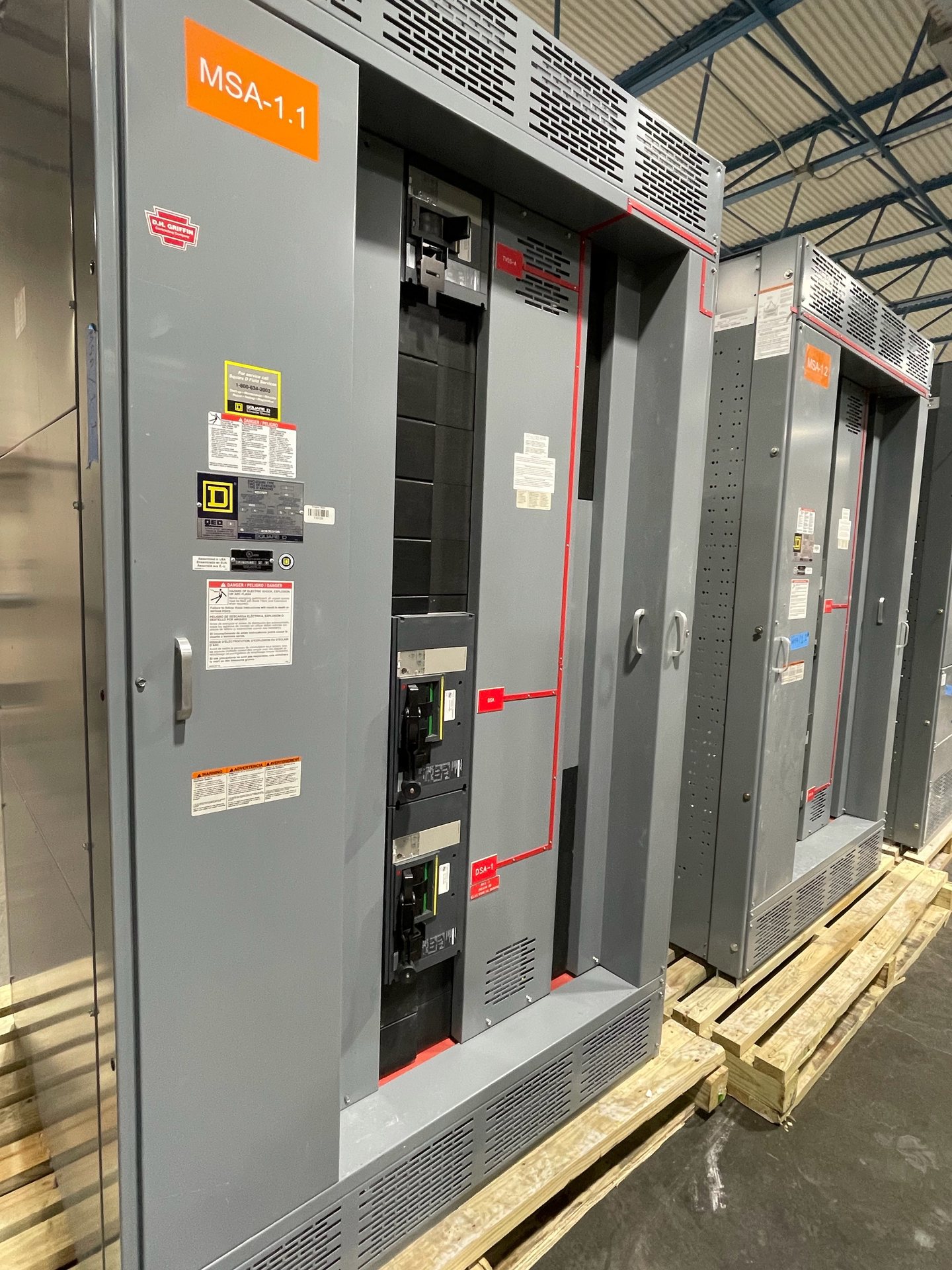
Start with the lineup record, not a count of breakers
A surplus inventory may describe a metal-clad lineup by sections, cubicles, or recorded breaker positions. Preserve the terminology used in existing schedules and drawings, then record the lineup identifier and the position labels as shown there. A total breaker count alone can obscure which assets are documented, which positions are empty, and which entries remain uncertain.
Keep lineup identification separate from breaker identification. A lineup label may refer to an assembly, while a breaker record may carry its own tag, nameplate details, or drawing reference. If those records are not available or do not agree, mark the difference rather than selecting one identifier as definitive. This separation helps a prospective buyer review the inventory without treating related equipment as interchangeable.
Record occupied, empty, and unknown positions distinctly
For each recorded position, use a clear status such as documented breaker, recorded empty, or unknown. An empty position in a schedule is not necessarily proof of its present physical condition, and a position with no entry should not be silently counted as empty. State whether a status comes from an existing document, an accessible photograph, or another source, and leave unverified details unknown.
Conditional examples can clarify the inventory without turning assumptions into findings. If a drawing identifies a breaker at position 3 but no corresponding breaker record is available, list the position as documented in the drawing and the breaker identity as unknown. If a schedule marks position 4 as spare, preserve that wording; do not infer that a breaker is included or that the position is physically vacant.
Build breaker identity from available records
Where existing documentation is accessible, capture breaker identifiers exactly as written, including any recorded manufacturer, catalog or model reference, ratings, and asset tag. These fields may help distinguish one breaker from another, but their absence does not make seller testing necessary. If a field cannot be confirmed from records or existing photographs, label it unknown instead of estimating it from the position or a neighboring breaker.
A photograph may show a nameplate or exterior markings, but it does not establish every specification or the condition of the equipment. Share only photographs already available and safe to access. Do not open equipment, energize it, test it, or ask unqualified personnel to approach it for better images. Qualified professionals should handle electrical equipment; gaps in the inventory can remain explicit for review.
Do not equate position with compatibility
A breaker that fits a recorded cubicle position is not thereby confirmed as compatible with that lineup. Compatibility can depend on details not established by position alone, and a position number does not verify ratings, design, or other interface requirements. If a buyer’s intended application matters, provide the available supporting records and let the relevant qualified professionals assess suitability rather than making a claim from a position map.
This distinction matters when a surplus lot includes breakers removed at different times, records assembled from several sources, or positions described only by labels. For example, two entries with the same nominal position reference may still describe different assets or configurations. Record the source of each identifier and any conflict. Do not consolidate records merely because their labels look alike or assume a match where documentation is incomplete.
Make uncertainty visible in the sale inventory
A useful inventory can include lineup reference, recorded cubicle position, position status, breaker identifier, source of information, and notes on unresolved discrepancies. These are documentation fields, not a requirement to inspect or operate equipment. If a schedule and photograph appear inconsistent, retain both references and describe the conflict neutrally. A buyer can then review what is documented without mistaking a seller’s preliminary list for a verified technical finding.
Unknowns should be specific: for instance, “breaker identity not shown in available records” is more useful than a blank cell that could mean omitted, missing, or not applicable. Likewise, distinguish “recorded empty” from “condition not confirmed.” Do not fill gaps with presumed manufacturer, model, rating, condition, or history. Clear limits make it easier to identify which assets may be considered while keeping the scope of any offer contingent on review.
Prepare the records for a purchase review
Florida Switchgear Buyers considers used, surplus, and decommissioned switchgear and related equipment in all voltage classes, including equipment from decommissioned data centers and closed power plants. A potential sale may include a documented lineup, individual breakers, or a mixture of identified and unknown positions; the precise assets purchased depend on review. No seller testing is required. For purchased equipment, the company handles crane, rigging, disconnects, loading, freight, and hauling.
Share available inventory records and accessible photographs for review by calling (614) 715-3047 or emailing saleselectricalbuyers@gmail.com. Florida Switchgear Buyers makes cash offers and pays upfront for equipment purchased. Those terms do not establish that every listed position or breaker will be included in an offer. The purchasing and removal scope concerns equipment purchased; it is not a promise of facility demolition or general electrical services.