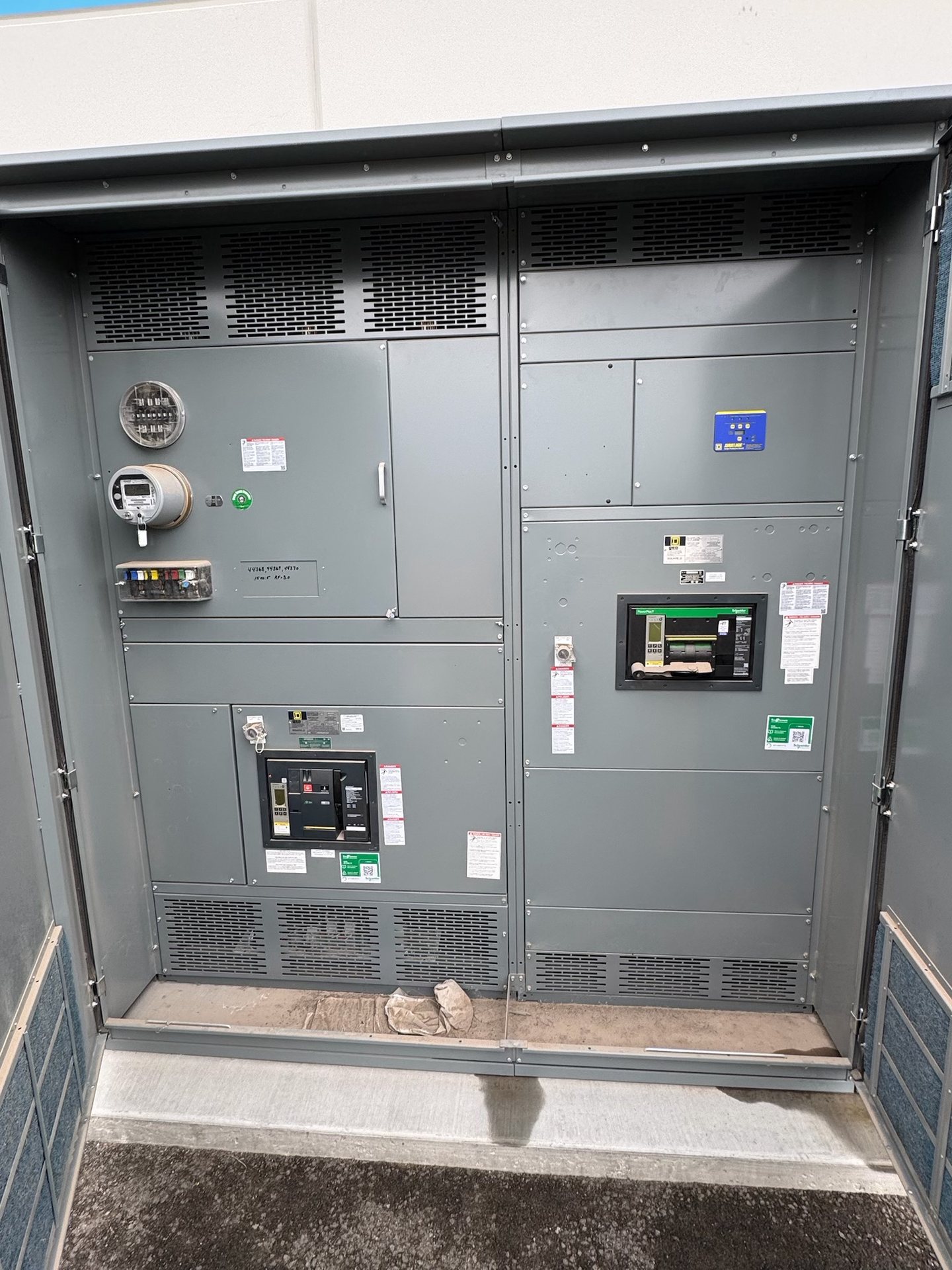
Start with the decision to sell the assembly
Imagine an owner planning a facility change who finds an MCC cabinet marked 600 volts and must decide whether to present it as one assembly or describe its sections separately. That distinction matters: the overall motor control center may have an assembly label, while individual units or compartments may carry their own identification. A marked rating helps identify the equipment, but it does not establish condition, operating voltage, completeness, or whether a buyer will purchase it.
For an initial description, keep the evidence and the interpretation separate. You might report that an accessible assembly label says 600 volts, then note separately that someone familiar with the installation reported a different operating voltage—or that no operating-voltage information is available. A rating is not proof of the facility’s actual system voltage or of interchangeability with another MCC. Leave uncertain details unknown instead of resolving them by assumption.
Distinguish assembly labels from unit labels
An MCC is not necessarily described fully by a single cabinet label. If existing records or safely accessible photographs show an assembly identifier and labels on individual units, share them as separate observations. Unit labels can help a reviewer understand what is included, but their presence alone does not establish that every expected unit is present or that units are compatible with another lineup. Do not infer a complete configuration from a partial view.
If labels are missing, obscured, or not documented, say so plainly. There is no need to open a compartment, remove a cover, or approach equipment to obtain more information. Only qualified professionals should handle electrical equipment, and the seller does not need to test it. Existing documentation and photographs can support a preliminary review; absent evidence should remain an open question for the buyer rather than a reason to guess.
Report operating voltage as reported, not verified
A seller may know the voltage associated with the installation from existing records or personnel familiar with its operation. If so, identify it as reported operating voltage and keep it distinct from the 600-volt marking. If no reliable record is available, state that the operating voltage is unknown. This wording gives a reviewer useful context without presenting a nameplate rating as confirmation of how the equipment was used or what supply it served.
The distinction can affect how a buyer evaluates the specific equipment, but it does not prove suitability for a proposed application. Similar-looking MCCs may differ in details that cannot be confirmed from a broad description, and a voltage label cannot establish interchangeability. Do not energize or test the lineup to answer questions. Florida Switchgear Buyers makes offers contingent on review of the equipment and does not require seller testing.
Describe completeness and visible external condition
Completeness is more useful when described in observable, limited terms. For example, existing records might identify the lineup and list certain units, while a photograph might show that some spaces appear unoccupied. Report what the records say and what the visible image shows separately; neither necessarily establishes the full contents or original configuration. If no inventory exists, say that the unit count or included components are unknown rather than estimating from a partial view.
Describe only visible external condition from information already available: perhaps the cabinet appears intact in a photograph, or visible exterior damage is documented. Such observations do not establish internal condition, operability, or whether components are missing. Avoid treating cleanliness, paint, or an apparently closed door as evidence that the MCC works. Do not inspect or handle equipment to improve the description; qualified professionals must manage electrical equipment and any related work.
Prepare a review that does not depend on testing
A useful preliminary submission can combine the assembly rating, any separately documented unit labels, reported operating voltage if known, completeness information, and existing photographs or records. Clearly mark each item as observed, documented, reported, or unknown. This lets a buyer assess the actual information available without turning assumptions into specifications. If labels conflict or records do not match visible details, identify the discrepancy rather than choosing one account as correct.
Florida Switchgear Buyers buys used, surplus, and decommissioned electrical switchgear and related equipment in all voltage classes, including equipment from decommissioned data centers and closed power plants. The company reviews the specific assets before making an offer; a 600-volt marking alone does not guarantee acceptance or determine value. Sellers are not required to test equipment, and only qualified professionals should handle it.
Clarify purchase scope and removal responsibilities
When equipment is purchased, Florida Switchgear Buyers handles crane work, rigging, disconnects, loading, freight, and hauling for the purchased equipment. That scope concerns removal and transportation of assets the buyer purchases; it should not be confused with wholesale facility demolition or general electrical services. Before proceeding, make clear which MCC assembly or individual assets are being offered, since the purchase scope depends on review of those specific items.
For questions or to share existing information, contact Florida Switchgear Buyers at (614) 715-3047 or saleselectricalbuyers@gmail.com. The company makes cash offers and pays upfront for equipment purchased. The precise assets purchased and any offer remain contingent on review, so do not assume that every unit, accessory, or related item is included simply because it appears in the same lineup. A clear inventory, with unknowns identified, helps keep the discussion focused on the equipment actually presented.