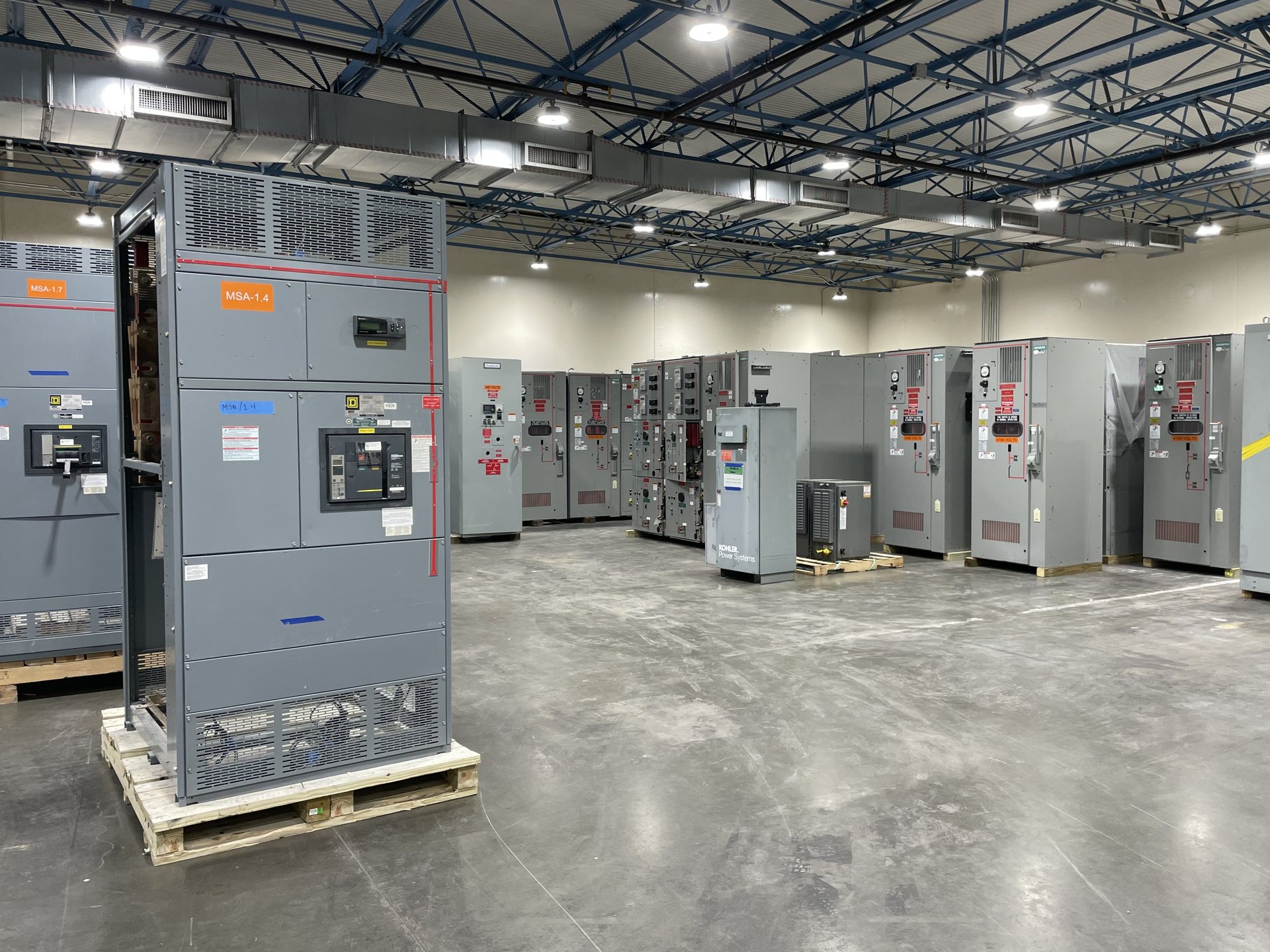
Treat 277/480 as a reported identifier
A 277/480-volt notation gives the buyer a useful starting point, not a complete description of the switchboard. It may appear in seller records, on a nameplate, or in a prior equipment list. Preserve the source of the notation: say whether it was read from an accessible label or supplied by another record, rather than presenting an unverified entry as a confirmed field observation.
The notation alone does not establish the voltage of the system where the assembly was used, its present condition, its phase or wiring arrangement, or whether it suits another installation. Those are separate questions for review by the buyer and qualified professionals. A seller need not resolve them before making an inquiry; clearly identifying what is known and what remains unknown makes the handoff more useful.
Define which assembly and sections are included
Describe the offered scope in terms that let a decision maker distinguish the switchboard from adjacent equipment. If the potential sale concerns one lineup within a larger electrical room, state that distinction and identify any sections that may be included, if known. Avoid treating connected or nearby gear as part of the offer simply because it appears in the same photograph or equipment schedule.
Where accessible records use section labels, lineup identifiers, or device descriptions, share those as recorded and note any uncertainty about how they map to the physical assembly. A partial scope may be reviewable, but the precise assets purchased depend on review. Florida Switchgear Buyers buys used, surplus, and decommissioned switchgear and related equipment across voltage classes; that does not mean every section or associated device will be included.
Share ratings without turning them into conclusions
If existing documentation or accessible nameplate photographs show separate assembly and device ratings, keep those details distinct when passing them along. A seller might report a 277/480 notation for the assembly while a listed device has its own marked rating. Transcribing each label as it appears is more informative than compressing several markings into one claim about the entire lineup.
A marking is an identifier, not proof that equipment operates as marked or that a replacement is interchangeable. Do not infer compatibility, interrupting capability, present condition, or market value from a voltage notation or a device label. If a rating is unreadable, absent from available records, or uncertain, call it unknown. No seller testing is required to fill that gap.
Make the document handoff traceable
A concise handoff can pair each known detail with its source: an existing equipment schedule, a prior inventory, or a photograph already available to the seller. Keep the document’s own terminology where possible and flag conflicting entries rather than choosing one without a basis. This helps the decision maker explain what is being offered and gives the buyer specific material to assess.
Useful supporting material can include accessible views of labels and the overall assembly, along with records that identify the sections in scope. Do not open panels, energize equipment, test devices, or approach equipment to obtain better images. Only qualified professionals should handle electrical equipment. If photographs or documents are unavailable, say so; their absence does not require the seller to perform testing.
Keep unknown system details explicit
Phase and wiring details may be important, but a 277/480 notation does not by itself verify either one. If a reliable existing record states a configuration, attribute it to that record. If the seller has only the voltage notation, report the phase and wiring as unknown rather than translating the notation into an assumed arrangement.
This distinction is especially useful when information passes through several people. An owner or representative may provide records to a decision maker, who then sends a summary to the buyer. Marking reported facts, document-derived facts, and unknowns separately reduces the chance that an assumption becomes a claimed specification. The buyer reviews the specific equipment; the seller is not expected to diagnose or verify it.
Coordinate review and removal for purchased assets
Florida Switchgear Buyers makes cash offers and pays upfront for equipment it purchases. An offer and the exact assets included are contingent on review, so a reported voltage or complete-looking document set should not be treated as acceptance or a value guarantee. For a purchase inquiry, contact (614) 715-3047 or saleselectricalbuyers@gmail.com and share the information already available.
For equipment purchased, the company handles crane, rigging, disconnects, loading, freight, and hauling. Sellers should not disconnect, move, isolate, or otherwise handle electrical equipment; only qualified professionals should do so. This purchasing and removal scope applies to purchased assets, not wholesale facility demolition or general electrical services. An incomplete record can be identified honestly and left for review rather than filled in by guesswork.